> For the complete documentation index, see [llms.txt](https://dione-protocol.gitbook.io/dione-whitepaper/llms.txt). Markdown versions of documentation pages are available by appending `.md` to page URLs; this page is available as [Markdown](https://dione-protocol.gitbook.io/dione-whitepaper/technology/governance.md).
# Governance
There are two dimensions of governance at Dione.
### 1. The Core Platform Governance
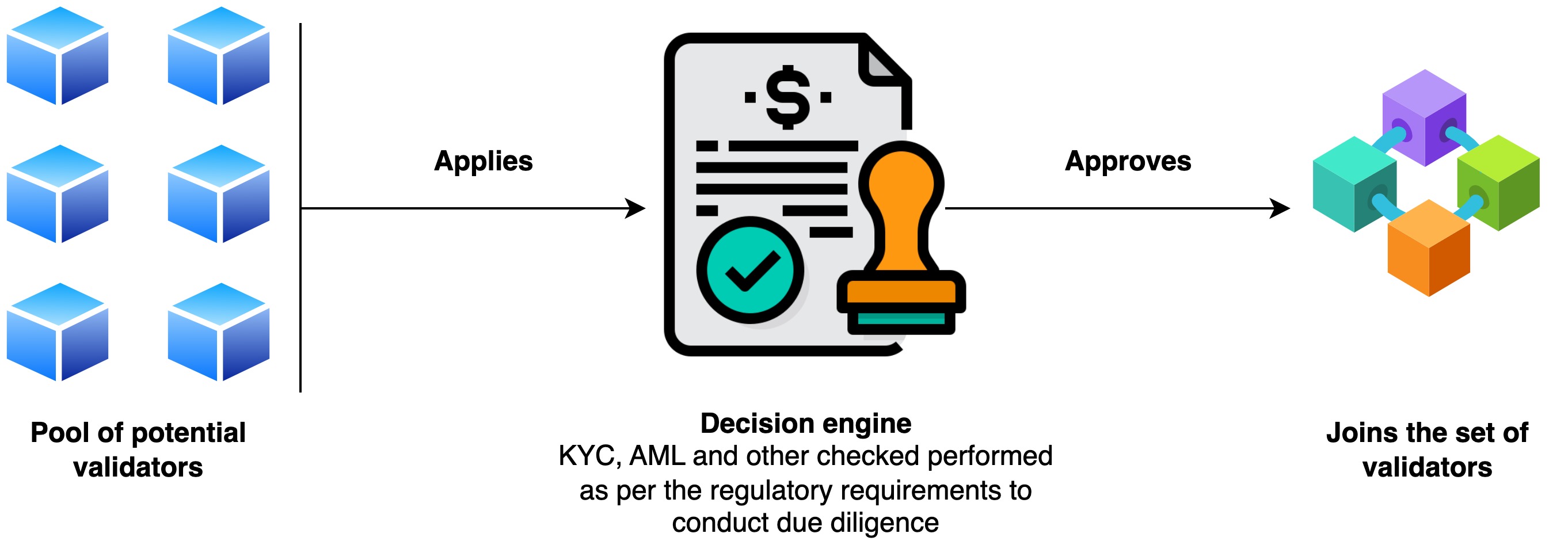
Due to the sensitive nature of the industry that we operate in and potential regulatory limitations, we will only allow vetted entities with the required minimum staked on the platform to take part in governance and decide the overall direction of the system. Therefore, a balance will be maintained to ensure regulatory requirements are met and the network is kept decentralized as well.
It should also be noted that the frequency a node is queried by its peers to take part in consensus depends on the amount the node has staked.
At this time, the following aspects will be subjected to governance decisions:
1. Security and threshold parameters
2. Addition and deletion of validators
3. Network-level updates
All of the governance decisions will be publicly announced to the community.
### 2. Governance for Projects Built on Top of Our Platform
We will allow L2 blockchains or dApps created on top of our blockchain to have internal governance as well, which will be completely segregated from Dione Protocol’s core governance.
For L2 projects, we enable infinite inclusion. It ultimately allows dApp developers to define the configuration whether they want every token holder to be a voter in governance decisions or they prefer to define voting rules based on several parameters.